Chiral LC
Clone Chemistries
IEX/Ligand Exchange
Ion Chromatography
HPLC


Liquid chromatography (LC) is a powerful and versatile analytical technique used to separate, identify, and quantify components in complex mixtures across industries such as pharmaceuticals, biotechnology, environmental analysis, and food testing. The technique relies on the interaction between analytes, the stationary phase, and the mobile phase, enabling precise separation of compounds based on their chemical or physical properties.
At Phenomenex, we offer comprehensive types of liquid chromatography solutions encompassing a broad range of brands, separation modes, particle technologies, column formats, and accessories. From high-efficiency core-shell and fully porous particles to robust polymer-based and hybrid columns, our products are engineered for superior resolution, reproducibility, and throughput. Whether your focus is on analytical, micro, or preparative-scale separations, our LC portfolio supports diverse applications from small-molecule analysis to complex biomolecule characterization.
Explore our solutions to find the ideal liquid chromatography columns, consumables, and accessories tailored to your workflow, delivering reliable results and enhanced laboratory performance.
Explore our extensive range of trusted, premier LC brands, each offering cutting-edge technology and exceptional quality to address your unique analytical requirements with precision and readability.
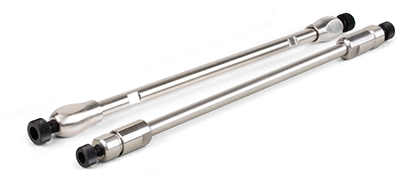
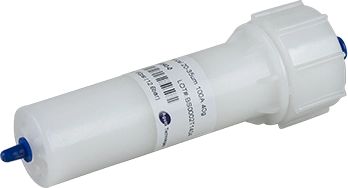
Liquid chromatography is used to separate and analyze compounds in complex mixtures. It is essential in pharmaceutical quality control, biopharmaceutical analysis, environmental testing, and metabolomics, where precise identification and quantification are critical.
LC columns are categorized based on their separation mechanism:
HPLC and UHPLC differ mainly in particle size, column dimensions, operating pressure, and flow rate. UHPLC uses particles ≤2 µm, while HPLC typically uses 3–5 µm particles, giving UHPLC higher efficiency and sensitivity. UHPLC columns are shorter (≈100 mm × 2.1 mm ID) and operate at pressures up to 1,500 bar, compared to 400–600 bar for HPLC. Flow rates are lower in UHPLC (0.2–0.7 mL/min) than in HPLC (1–2 mL/min). These features make UHPLC ideal for fast, high-resolution separations of complex samples, while HPLC remains suitable for routine analyses like water purity and impurity profiling.
Choose the column type based on your analyte: reversed-phase for non-polar, normal-phase for polar, ion-exchange for charged species, and size-exclusion for large biomolecules. Column length, internal diameter, particle, and pore size influence resolution, speed, and pressure. Smaller particles and larger pores improve resolution and accommodate larger molecules. Ensure stationary phase chemistry and materials are compatible with your mobile phase and system conditions. For specialized needs, use chiral or affinity columns from reliable manufacturers for consistent performance.
Proper sample preparation ensures accuracy, sensitivity, and system reliability. It removes interferences, particulates, and residues that can distort signals or damage columns. Techniques such as solid-phase or liquid-liquid extraction, filtration, and pH adjustment improve peak shape, reproducibility, and detection limits—protecting instruments and ensuring robust, compliant results.